What Is Ptosis and Why Does the Eyelid Droop?
Quick Answer
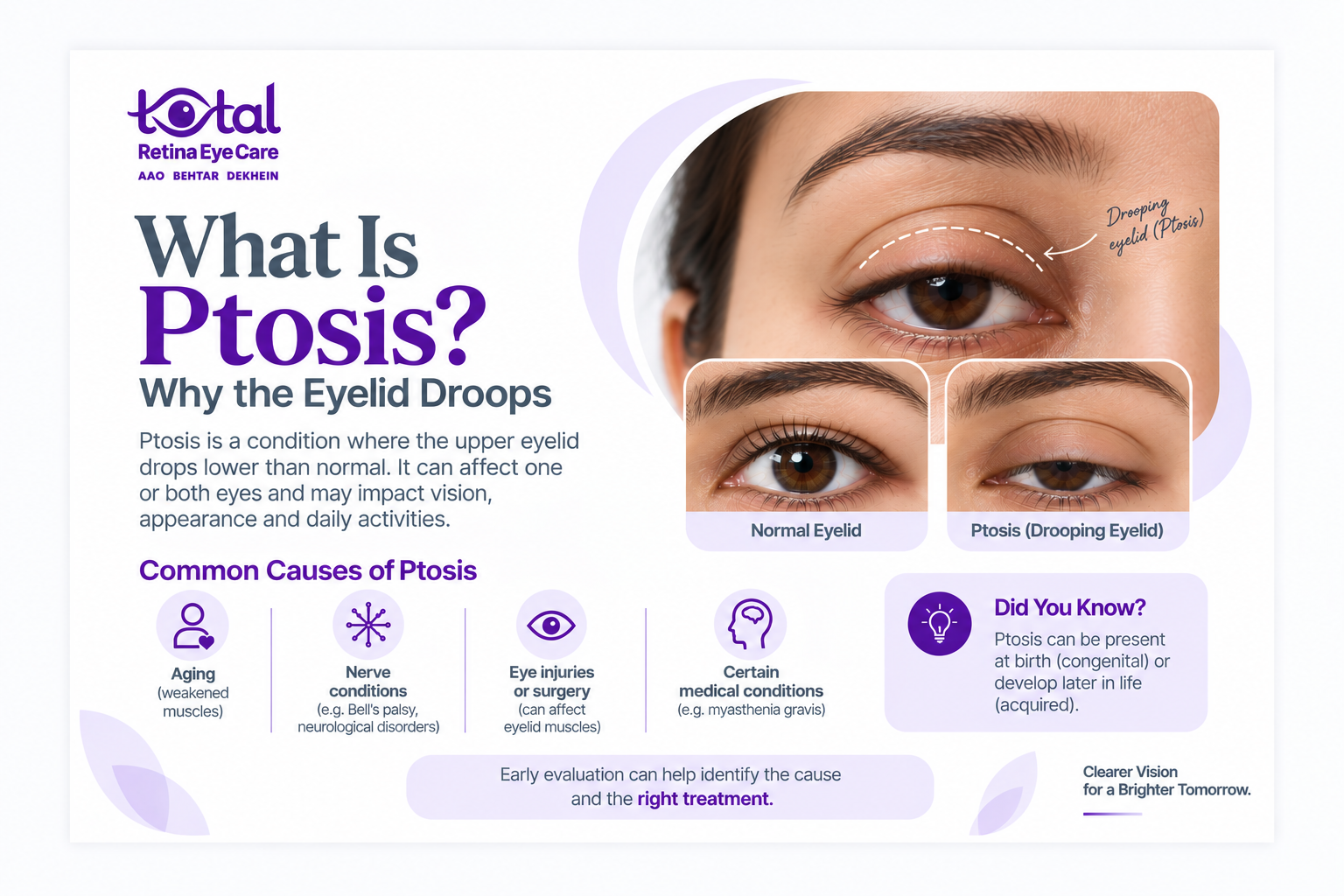
Ptosis is the medical term for a drooping upper eyelid. It happens when the muscle responsible for lifting the lid becomes weak or loose. It may affect one eye or both, and it can develop slowly with age, follow years of contact lens wear, or appear suddenly because of a nerve or muscle problem. Some children are even born with it. While a mild droop is often just a cosmetic difference, a more pronounced one can block part of the vision and should be checked by an eye specialist. At our eye clinic in Nagpur, this is one of the most common eyelid concerns patients bring to an oculoplastic surgeon in Nagpur for evaluation.
The upper eyelid is raised by the levator muscle, assisted by a smaller supporting muscle near the lid margin. Ptosis develops when this lifting system stops working as it should the muscle itself may have weakened, the tendon linking it to the eyelid may have stretched or come loose, or the nerve signal reaching the muscle may be disrupted. Whatever the reason, the eyelid ends up sitting lower than normal, sometimes barely noticeable and sometimes low enough to interfere with the upper field of vision.
Ptosis is not one single condition it is a symptom with several possible causes, and identifying the correct one is what determines the right treatment.
• Age-related (involutional) ptosis — the most common form. Over time, the tendon connecting the levator muscle to the eyelid stretches or loosens, causing the lid to sink lower.
• Congenital ptosis — present from birth, usually because the levator muscle has not developed completely. Parents often notice this early, when one eye appears smaller or the child tilts the head back to see better.
• Contact lens–related ptosis — years of wearing contact lenses, particularly rigid ones, can stretch the eyelid tissue and cause a similar loosening over time.
• Neurological or muscular causes — certain nerve or muscle disorders can weaken the eyelid, and any sudden droop, especially with double vision, calls for prompt evaluation.
• Post-surgical or trauma-related ptosis — can appear after eye surgery or an injury to the eyelid or the tissue around it.
A mild droop is usually just a visible difference between the two eyelids, with no real impact on sight. But as it progresses, it can begin blocking part of the upper visual field, particularly when looking straight ahead or upward. Many patients compensate without noticing constantly raising their eyebrows or tilting the head back which can eventually lead to strain and headaches. This is generally the stage where ptosis stops being a cosmetic observation and becomes worth a proper evaluation at a dedicated eye clinic in Nagpur.
A ptosis evaluation looks at how much the eyelid has dropped, how well the levator muscle is still functioning, and whether the droop is affecting the visual field. This usually includes:
• Measuring the eyelid height and margin position on each side
• Testing levator muscle strength and movement
• A visual field assessment if the droop looks significant
• A general eye examination to rule out other contributing factors
This assessment helps decide whether treatment is necessary and, if it is, which surgical approach is most likely to give a natural, lasting result. Patients looking for the best eye hospital Nagpur has to offer for this kind of evaluation should look for a centre with dedicated oculoplastic expertise rather than a general eye check-up alone.
Yes, in most cases. Ptosis is typically corrected through a surgical procedure that either tightens or repositions the levator muscle, depending on how much function remains. It is a well-established, evidence-based treatment with predictable outcomes for most patients. That said, the exact technique depends on the underlying cause and the muscle's remaining strength a decision an experienced oculoplastic surgeon in Nagpur makes only after a thorough examination, not something that can be generalised across cases.
Is ptosis always related to age?
No. While age-related ptosis is the most common form in adults, it can also be present from birth, linked to long-term contact lens use, or caused by a nerve or muscle condition. The underlying cause needs to be identified before deciding on treatment.
Can ptosis affect just one eye?
Yes, it is quite common for ptosis to affect only one eyelid, though both eyes can be involved as well.
Does ptosis get worse over time if left untreated?
In many age-related cases, yes — it can gradually progress. How quickly it worsens, and whether treatment is needed, depends on the individual case and is best assessed directly by a specialist.
Will surgery leave a visible scar?
Ptosis surgery is generally performed through the natural eyelid crease, which helps the resulting scar blend in well as it heals, though individual healing does vary.
Is ptosis surgery only for cosmetic reasons?
Not necessarily. While some patients seek treatment purely for appearance, ptosis that affects the visual field is considered a functional issue, not just a cosmetic one.
If you have noticed a drooping eyelid in yourself or your child, an evaluation at a trusted eye clinic in Nagpur is the first step toward the right diagnosis and treatment plan. As one of the centres regarded among the best eye hospital Nagpur has for oculoplastic care, we offer thorough ptosis assessments led by an experienced oculoplastic surgeon in Nagpur.
📍 Mehadia Bhawan, Lokmat Square, Dhantoli, Nagpur, Maharashtra 440012
📞 074209 55541
🌐 www.totalretinaeyecare.in
