Quick answer: A toric lens is a special lens placed during cataract surgery to correct astigmatism along with the cataract. It suits people who have a cataract and a meaningful, regular amount of astigmatism, and who want clearer distance vision with less dependence on glasses.
What Is a Cataract?
The natural lens inside your eye is clear, like a clean window. With age it slowly turns cloudy. This cloudiness is a cataract. Vision becomes blurry, dull or hazy, and lights may glare at night.
Cataract surgery removes the cloudy lens and replaces it with a clear artificial lens called an intraocular lens (IOL). The IOL stays in your eye for life.
What Is Astigmatism?
A healthy cornea, the clear front surface of the eye, is shaped like a round cricket ball. In astigmatism it is shaped more like a rugby ball or the back of a spoon: it curves more in one direction than the other.
Because of this, light does not focus on a single point, and objects look blurred or stretched at all distances. Many people with cataract also have astigmatism, and may have carried a cylinder number in their glasses for years.
Here is the key point: a regular lens does not correct astigmatism. After surgery you may see more clearly, but you will probably still need glasses to remove the blur caused by astigmatism.
What Is a Toric Lens?
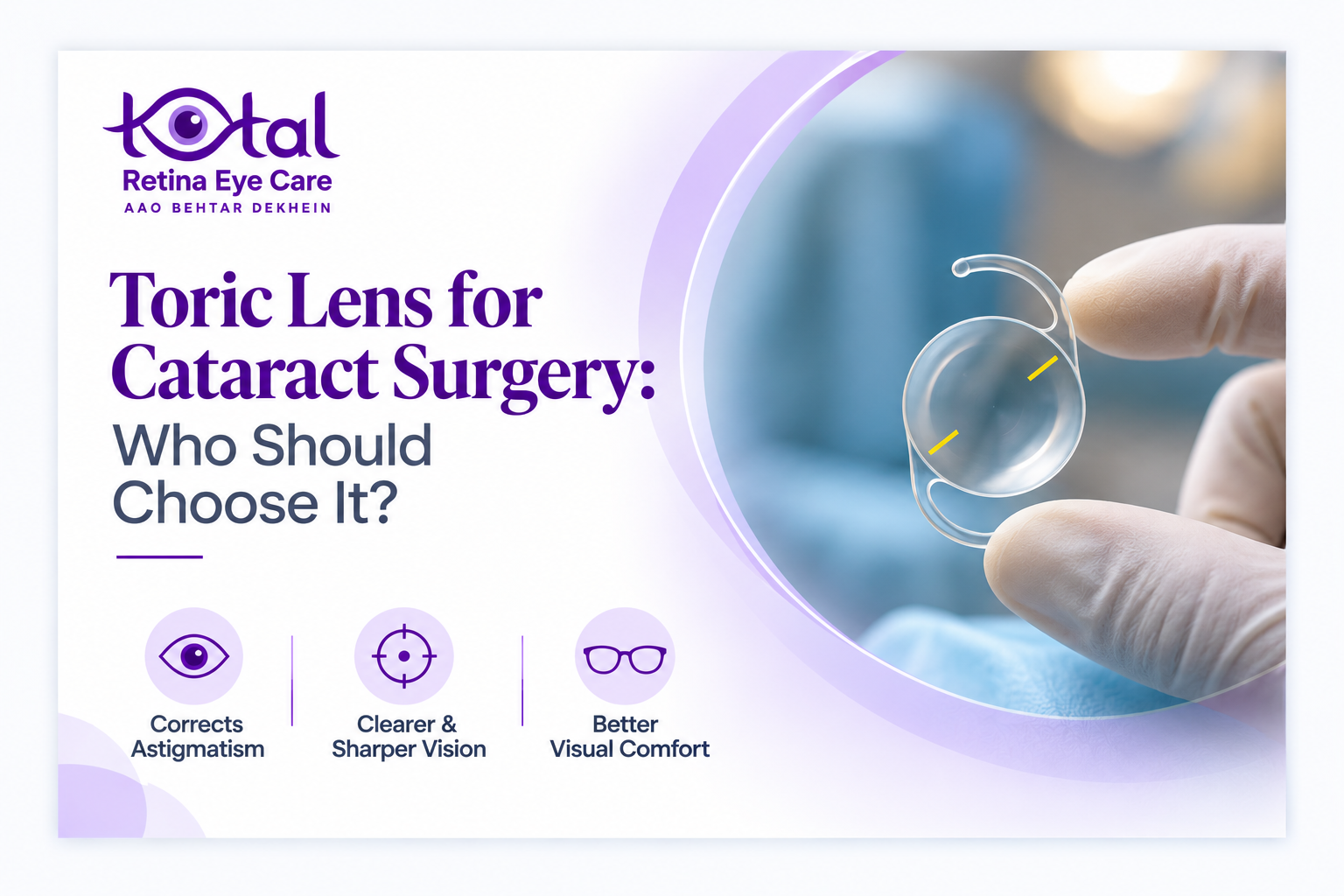
A toric lens is an artificial lens with astigmatism correction built in. It has extra power along one direction, which cancels the uneven curve of your cornea. One lens treats two problems: the cataract and the astigmatism.
A toric lens works only when it sits at the exact angle. That is why your surgeon measures your eye carefully before surgery and marks the correct position on the day.
Benefits of Toric Lens Cataract Surgery
- Clearer distance vision with less need for thick glasses
- Less dependence on glasses for driving, watching TV or walking outside
- Sharper vision, because the stretched, blurred look of astigmatism is treated
- Two problems, one surgery: cataract and astigmatism together
- A long-lasting result: the lens stays in your eye for life
Who Should Choose a Toric Lens?
A toric lens may suit you if:
- You have a meaningful amount of astigmatism. This usually means a cylinder number of about 1.0 or more, in your glasses or on the doctor’s measurements.
- Your astigmatism is regular. The cornea has a smooth, even shape, which special eye scans can confirm.
- You want less dependence on glasses for distance. For example, you are tired of strong glasses or want to drive without them.
- Your eyes are otherwise healthy. The retina, optic nerve and cornea are in good condition.
- Your expectations are realistic. You understand that a toric lens improves distance vision, but you may still need reading glasses.
Who May Not Be Suitable for a Toric Lens?
Your doctor may advise a regular lens if you have:
- Very little astigmatism: the benefit is too small to justify the extra cost
- An uneven or irregular cornea: for example, keratoconus or a corneal scar
- Untreated dry eye or surface problems: they can make the measurements inaccurate
- A weak lens support system: after an eye injury, or in some conditions, the lens may not stay steady in one position
- Other eye diseases, such as advanced glaucoma or retina (macular) disease, which can limit the visual benefit
- Unrealistic hopes of being free from glasses for everything
Some toric lenses also help with intermediate or near vision. Ask your surgeon whether these suit your eyes. Please ask the hospital for a written estimate before you decide.
How Is Toric Lens Surgery Planned?
Good planning is the key to a good result. Before surgery, the doctor will:
- Scan your cornea to measure its shape and curve
- Measure the length of your eye and other details to choose the right lens power
- Check the surface of your eye, and treat dry eye first if needed
- Mark the lens position on your eye on the day of surgery, so the lens can be placed at the exact angle
The surgery itself is very similar to routine cataract surgery. It is a day-care procedure, usually done with numbing eye drops, and takes a short time.
What to Expect After Surgery
- Vision usually starts improving within a day or two, and may take a few weeks to settle fully.
- You will use eye drops for a few weeks, as your doctor advises.
- A mild scratchy feeling, watering or glare in the first few days is common.
- Avoid rubbing the eye, and protect it from dust and water as advised.
- Attend every follow-up visit. The doctor checks that the lens is sitting in the correct position.
- You may still need reading glasses, or a light glasses power for fine-tuning.
Risks and Limits You Should Know
Toric lens surgery is safe and well established, but like any surgery it carries some risk. The general risks of cataract surgery, such as infection, swelling or inflammation, apply to every type of lens.
Specific to toric lenses, the lens can rotate slightly from its correct position. When this happens, the astigmatism correction becomes less effective and vision may look blurry. It is uncommon and usually happens in the first few weeks. If it does, the doctor can often turn the lens back into place with a small procedure.
Also, the result is not perfect for everyone. Some people still need a thin pair of glasses for their best vision.
Choosing Cataract Surgery in Nagpur: What to Look For
If you are comparing clinics for cataract surgery in Nagpur, these questions help you decide:
- Will my cornea be scanned and measured carefully before the lens is chosen?
- Will my retina and optic nerve be checked too, since they affect how well I can see after surgery?
- Which lens options suit my eyes, and why? Can I get the costs in writing?
- Who will operate, and who will see me for follow-up visits?
- What happens if the lens needs adjusting after surgery?
A clinic that answers these clearly is a good sign. Do not choose on price or lens brand alone.
Cataract Surgery at Total Retina Eye Care, Dhantoli
Total Retina Eye Care is at Mehadia Bhawan, Lokmat Square, Dhantoli, Nagpur. Our eye specialists, including Dr. Sneha Agrawal, a cataract and cornea specialist, examine your eyes in detail before suggesting a lens. Our team also includes retina specialists, so your retina is assessed during the check-up. This helps us tell you honestly whether a toric lens is likely to help you.
When Should You See an Eye Doctor?
Please book an eye examination if:
- Your vision is cloudy, glary or blurry and glasses no longer help
- You have been told you have both cataract and astigmatism
- You are tired of wearing strong or thick glasses
- You want to know which lens options suit your eyes and your lifestyle
Frequently Asked Questions
1. Does a toric lens cure astigmatism?
It corrects the astigmatism in the eye that has the lens. The lens stays in your eye for life, so the correction is long-lasting. You may still need glasses for reading or fine-tuning.
2. Will I be completely free from glasses?
Not always. A toric lens mainly improves distance vision, and many people still use reading glasses. Some special toric lenses reduce the need for them. Your doctor will explain what to expect for your eyes.
3. Is toric lens surgery painful?
No. The surgery is done with numbing drops, and most people feel only light pressure. A mild scratchy feeling afterwards is common and settles in a few days.
4. How much astigmatism do I need to have?
A cylinder number of about 1.0 or more is usually worth treating with a toric lens. Your doctor will check your eye scans to decide.
5. Can I get a toric lens in both eyes?
Yes, if both eyes have a cataract and enough astigmatism. Surgery is usually done one eye at a time, a few days or weeks apart.
6. Can I just wear glasses for astigmatism after a regular lens?
Yes. This is a safe choice for many people, and it costs less. A toric lens is for those who want less dependence on glasses.
7. Does a toric lens wear out or need to be changed?
No. The lens is made to stay in your eye for life and does not need replacing.
How do I know if toric lens cataract surgery is right for me?
You need a full eye examination with corneal scans, eye measurements and a retina check. Based on these, your doctor can tell you whether a toric lens, a regular lens or another option fits your eyes and lifestyle. If you are looking for cataract surgery in Nagpur, you can book this check-up at Total Retina Eye Care in Dhantoli.
How much does cataract surgery in Nagpur cost?
The cost depends on the type of lens, the technique, the hospital and the tests needed. A toric lens usually costs more than a regular lens. Ask the clinic for a written estimate that lists the lens and all charges before you decide.
Final Thoughts
Choosing a lens for cataract surgery is a personal decision. A regular lens clears the cataract. A toric lens clears it and also treats astigmatism. If you have a good amount of regular astigmatism and want clearer distance vision with fewer glasses, toric lens cataract surgery is worth discussing with your doctor.
If you are looking for cataract surgery in Nagpur, book a complete eye check-up at Total Retina Eye Care, Mehadia Bhawan, Lokmat Square, Dhantoli, Nagpur. Call +91 74209 55541 to schedule your visit.
