
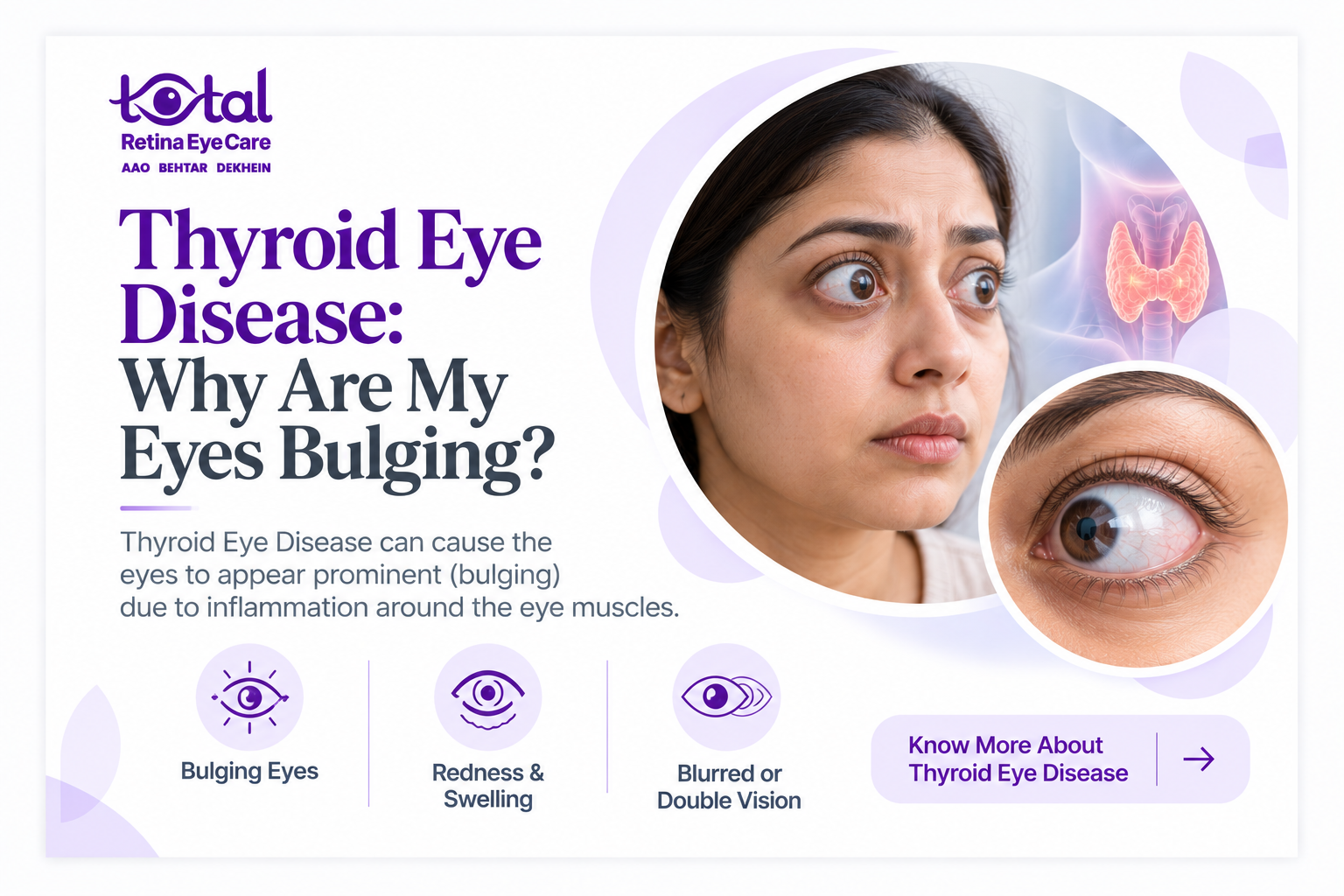
Thyroid Eye Disease: Why Are My Eyes Bulging?
Quick answer: Thyroid eye disease (TED) is an autoimmune condition. The immune system attacks the muscles and fat behind the eyes, they swell, and the eyes are pushed forward. It is most often seen with an overactive thyroid, but it can also occur when thyroid levels are normal or low. Because it can affect eye movement and, in rare cases, vision, early assessment by an oculoplastic surgeon in Nagpur is worth doing.
Many patients tell us the same thing. For months, people have said they look tired. Photos show eyes that seem wider or different. A family member usually notices first. If the thyroid problem is already known, the eye changes get put down to the thyroid tablets or to stress. That is a common misunderstanding. The eyes have a condition of their own, running alongside the thyroid, and it deserves separate attention.
Your eyes sit in a bony socket called the orbit. In thyroid eye disease, the immune system mistakenly targets the muscles that move the eye and the fatty tissue around them. These tissues swell and need more room. The socket cannot expand, so the eye is pushed forward, giving a prominent or staring look. Swelling can also lift the upper eyelid, which makes the eyes look even wider.
The eye disease and the thyroid do not always move together. Some people notice eye changes before any thyroid problem is diagnosed. Others continue to have eye symptoms even after thyroid levels are well controlled.
• Eyes that look more prominent or "staring" than before
• Redness, grittiness or a burning feeling
• Puffy eyelids, especially the upper lids
• Watering or sensitivity to light
• Double vision, particularly when looking sideways or upward
• A sense of pressure or fullness behind the eyes
• Trouble closing the eyes fully, especially during sleep
You may have only some of these. Mild cases may show just dryness and eyelid changes, while others have obvious bulging or double vision. The two eyes can also be affected unequally.
Thyroid eye disease is most often linked with Graves' disease (overactive thyroid), although it can accompany other thyroid conditions. Smoking is among the strongest risk factors. Smokers develop the disease more often, tend to have more severe disease, and usually respond less well to treatment. Women are diagnosed more often, but when men develop it, it can be more severe.
Thyroid eye disease is uncommon in children and, when it does occur, tends to be milder than in adults. Still, it should not be ignored. If your child has a known thyroid condition and you notice prominent eyes, red or watery eyes, swollen eyelids, a new squint, or complaints of double vision, an examination by a child eye doctor in Nagpur is a sensible step. Children may not describe their symptoms clearly, so changes that parents see in the eyes matter. Bulging or uneven-looking eyes in a child can also have other causes, and an eye specialist can sort out which one it is.
Most cases develop slowly and can be evaluated calmly. A small number of patients, however, develop pressure on the optic nerve, which can threaten eyesight. See an eye specialist promptly if you notice:
• Vision that is dim, blurred or washed out, especially in one eye
• Colours that look faded compared with before
• Double vision that is getting worse
• An eye that will not close, with increasing pain or a raw feeling on the surface
The assessment is usually simple and painless. Your doctor will measure how far the eyes protrude, check eyelid position and closure, test eye movements and colour vision, examine the optic nerve, and look at the surface of the eye for dryness or damage. Thyroid blood tests are usually needed, and a CT or MRI scan of the orbits is sometimes advised. Your eye specialist and the physician treating your thyroid often work together.
Treatment depends on how active the disease is and how much it troubles you. It may include:
• Lubricating drops and ointments for dryness and irritation
• Good thyroid control, in coordination with your physician
• Stopping smoking, which can genuinely change how the disease behaves
• Anti-inflammatory treatment during the active, inflamed phase, chosen case by case
• Prisms in spectacles to relieve double vision, in selected patients
• Surgery once the disease has settled: orbital decompression, eye muscle surgery or eyelid surgery, depending on the main problem
The disease typically has an active phase lasting many months, followed by a stable phase. Surgery for appearance or double vision is usually planned after things have settled, unless vision is at risk. The right plan differs from person to person and is decided after examination.
An oculoplastic surgeon specialises in the eyelids, the tear system and the orbit, which are exactly the structures affected in thyroid eye disease. If you are looking for an oculoplastic surgeon in Nagpur, this is the specialist who can assess bulging, eyelid retraction and closure problems together, guide you through the active phase, and plan orbital or eyelid surgery when it is needed.
If you are searching for the best eye hospital in Nagpur, it helps to look beyond the name. For thyroid eye disease, a good centre should offer:
• Access to an oculoplastic surgeon along with other eye specialists under one roof
• Proper testing, including exophthalmometry, colour vision, optic nerve assessment and orbital imaging
• Coordination with your endocrinologist or physician
• Care for all ages, including a child eye doctor for younger patients
• Honest guidance on when to wait and when to operate
1.Will my eyes return to normal once my thyroid is controlled?
Not always. Thyroid control is important, but the eye disease can follow its own course. Some people improve considerably; others are left with mild bulging or eyelid changes that can be corrected later.
2.Can it affect just one eye?
Yes. Both eyes are usually involved, but one may be worse than the other, and occasionally only one eye is affected.
3.Is thyroid eye disease painful?
Most people feel pressure, grittiness or a dull ache rather than sharp pain. Pain that is increasing, especially on moving the eyes, should be checked.
4.Can I have it without a known thyroid problem?
Yes. Eye symptoms can come first, or thyroid tests may look close to normal. If your eyes have changed, get both an eye examination and thyroid tests done.
5.Does quitting smoking really help?
Yes. It is one of the most useful steps you can take, as smoking raises the chance of developing the disease and makes its course harder.
6.Will I need surgery?
Many people do not. Mild disease is often managed with drops, thyroid control and monitoring. Surgery is considered for threatened vision, persistent double vision, or appearance concerns once the disease has settled.
7.How long does the active phase last?
It varies, but often runs from several months to a couple of years. After examining you, your surgeon can tell you which phase you are in.
8.Can children get thyroid eye disease?
It is uncommon in children and usually milder, but possible. A child with a thyroid condition and any eye changes should be seen by a child eye doctor.
Notice changes in your eyes or your child's eyes? Book an examination.
Mehadia Bhawan, Lokmat Square, Dhantoli, Nagpur, Maharashtra 440012
Contact us:-74209 55541
https://www.totalretinaeyecare.in/
