
Is the 20-20-20 Rule Enough for Digital Eye Strain?
Quick Answer
Yes -the 20-20-20 rule genuinely helps with digital eye strain, but it only addresses one part of the problem: focusing fatigue. It won't fully resolve dryness, grittiness, or burning caused by reduced blinking, poor screen distance, or an outdated glasses prescription. For lasting relief, most patients do best pairing the rule with better blinking habits, a properly set-up screen, and a check-up with an eye specialist in Nagpur if symptoms persist.
I get asked about this rule almost as often as I get asked about reading glasses these days usually by patients in their late 20s and 30s who are on screens ten to twelve hours a day and can't figure out why their eyes feel gritty by evening. Short version: it helps. It's just not the complete fix people assume it is.
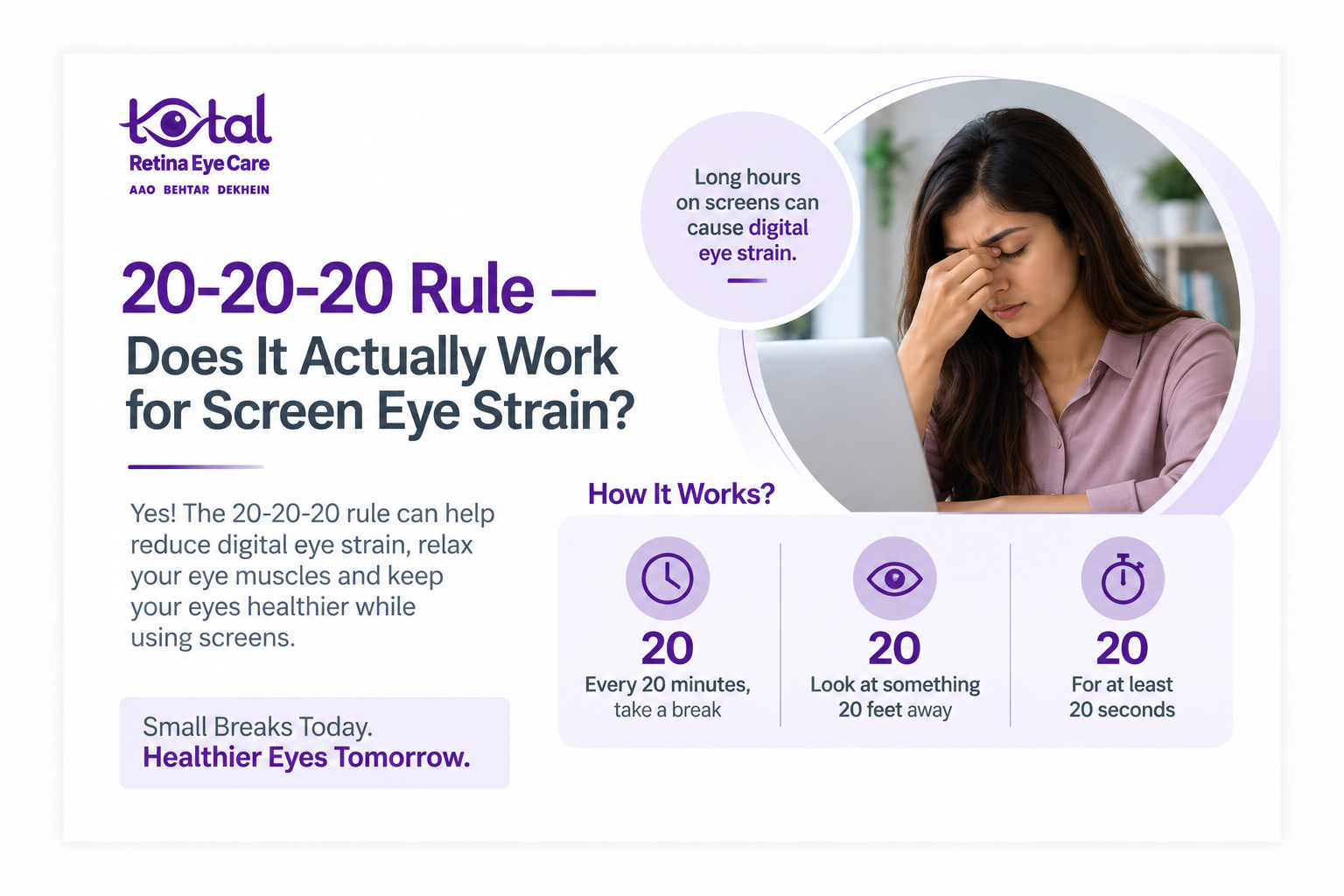
Every 20 minutes, look at something about 20 feet away for at least 20 seconds. That's the whole rule. The idea behind it is simple: the tiny focusing muscle inside your eye needs a break from the constant close-up effort of staring at a screen a foot or two from your face.
For part of the problem, yes. When you focus on something close for a long stretch, the muscle that controls your eye's lens stays contracted the whole time it's actually working, not just idling. Look away at something far off and it finally relaxes. Patients who stick with this for even a few days usually tell me their eyes feel less tired by the end of the day.
But focusing fatigue is only one piece of digital eye strain. The bigger piece the one behind most of the complaints I actually hear in clinic isn't something the 20-20-20 rule touches at all.
Stare at a screen and your blink rate drops, sometimes by more than half. Fewer blinks means your tear film doesn't get refreshed as often, and that's really what's behind most of the burning, dryness, and grittiness people lump together as “eye strain.” The 20-20-20 rule won't fix this on its own not unless you're also blinking fully, not halfway, during those 20-second breaks. Most people don't think to.
● Blink fully, not halfway, every few minutes especially when reading or concentrating hard
● Keep the screen at or just below eye level, at least an arm's length away
● If dryness sticks around, lubricating drops help — especially in air-conditioned rooms
● Match your screen brightness to the room; too bright or too dim against your surroundings adds strain
● Haven't had your eyes checked in over a year? An outdated prescription makes screens harder to focus on than they need to be
If you already wear glasses or contacts, an uncorrected or slightly-off prescription makes screen strain noticeably worse. Honestly, this is one of the most common things I catch in clinic, and it often has nothing to do with anyone's actual screen habits. If the 20-20-20 rule plus the tips above haven't helped after a couple of weeks, it's worth getting your eyes checked by an eye specialist in Nagpur rather than putting it down to “too much screen time.”
Not strictly, but most people actually stick with it if they set a reminder a phone alarm, a basic app, whatever's easy. Without one, it's easy to lose track on a busy day.
No it's functional, not structural damage. Address the underlying cause (blink rate, screen distance, prescription, dry eye) and the symptoms typically settle down.
Yes, and it's becoming more common given how much screen time schoolwork now involves. The same fixes apply: regular breaks, proper distance, and an eye check if symptoms don't ease up.
The evidence for lasting damage is thin. Blue light can interfere with sleep if you're on screens late at night, but the strain itself comes down to focusing effort and reduced blinking, not blue light.
Ordinary strain improves with rest and the basics above. Persistent pain, real blurring, or symptoms that don't budge despite taking breaks that's when it's worth an evidence-based eye examination rather than assuming it's just screen fatigue.
If digital eye strain is a daily, ongoing issue rather than an occasional evening thing, it's worth having it looked at properly rather than cycling through home remedies indefinitely. A comprehensive eye check refraction, tear film assessment, and a look at overall eye health can usually tell you within one visit whether you're dealing with simple strain, dry eye, or a prescription that needs updating.
Total Retina Eye Care in Dhantoli, Nagpur, offers this kind of comprehensive digital eye strain assessment under comfortable, evidence-based care. Many patients searching for a Best Eye Clinic in Nagpur or a Best Eye Hospital in Nagpur are, at the core, simply looking for a place that can accurately diagnose what's causing their screen-related discomfort and treat it appropriately rather than offer a one-size-fits-all fix.
📍 Mehadia Bhawan, Lokmat Square, Dhantoli, Nagpur, Maharashtra 440012
📞 074209 55541
🌐 https://www.totalretinaeyecare.in/contact
Reviewed by Dr. Sneha Agrawal, Eye Specialist, Total Retina Eye Care, Nagpur
