
Diabetes does not just affect your blood sugar — it quietly attacks the smallest, most delicate blood vessels in your body, and some of the most vulnerable ones sit right at the back of your eye, inside the retina. This condition is called diabetic retinopathy, and it is one of the leading causes of preventable blindness in India today. What makes it dangerous is not its severity — it is its silence. Most patients feel nothing unusual until the disease has already progressed significantly. As a retina specialist practising in Nagpur for over 15 years, I want to walk you through exactly how diabetes damages vision, why regular screening matters more than symptoms, and what treatment options are available if you are diagnosed early.
How Diabetes Damages the Retina
The retina is the light-sensitive layer at the back of the eye, and it depends on a dense network of tiny blood vessels to stay healthy. When blood sugar remains high over months and years, these vessels begin to weaken in a predictable pattern:
Stage 1: Mild Non-Proliferative Diabetic Retinopathy Tiny bulges called microaneurysms form in the retinal blood vessels. At this stage there are usually no symptoms at all, and the changes can only be detected through a dilated retina examination or an OCT (Optical Coherence Tomography) scan.
Stage 2: Moderate to Severe Non-Proliferative Retinopathy Blood vessels become more damaged, leaking fluid and blood into the retina. This is often when patients first notice mild blurring, but many still dismiss it as eye strain or the need for a new spectacle number.
Stage 3: Proliferative Diabetic Retinopathy This is the advanced and most dangerous stage. The retina, starved of oxygen, signals the body to grow new, abnormal blood vessels. These new vessels are fragile and can bleed into the eye (vitreous haemorrhage) or pull on the retina, causing a retinal detachment. Vision loss at this stage can be sudden and severe.
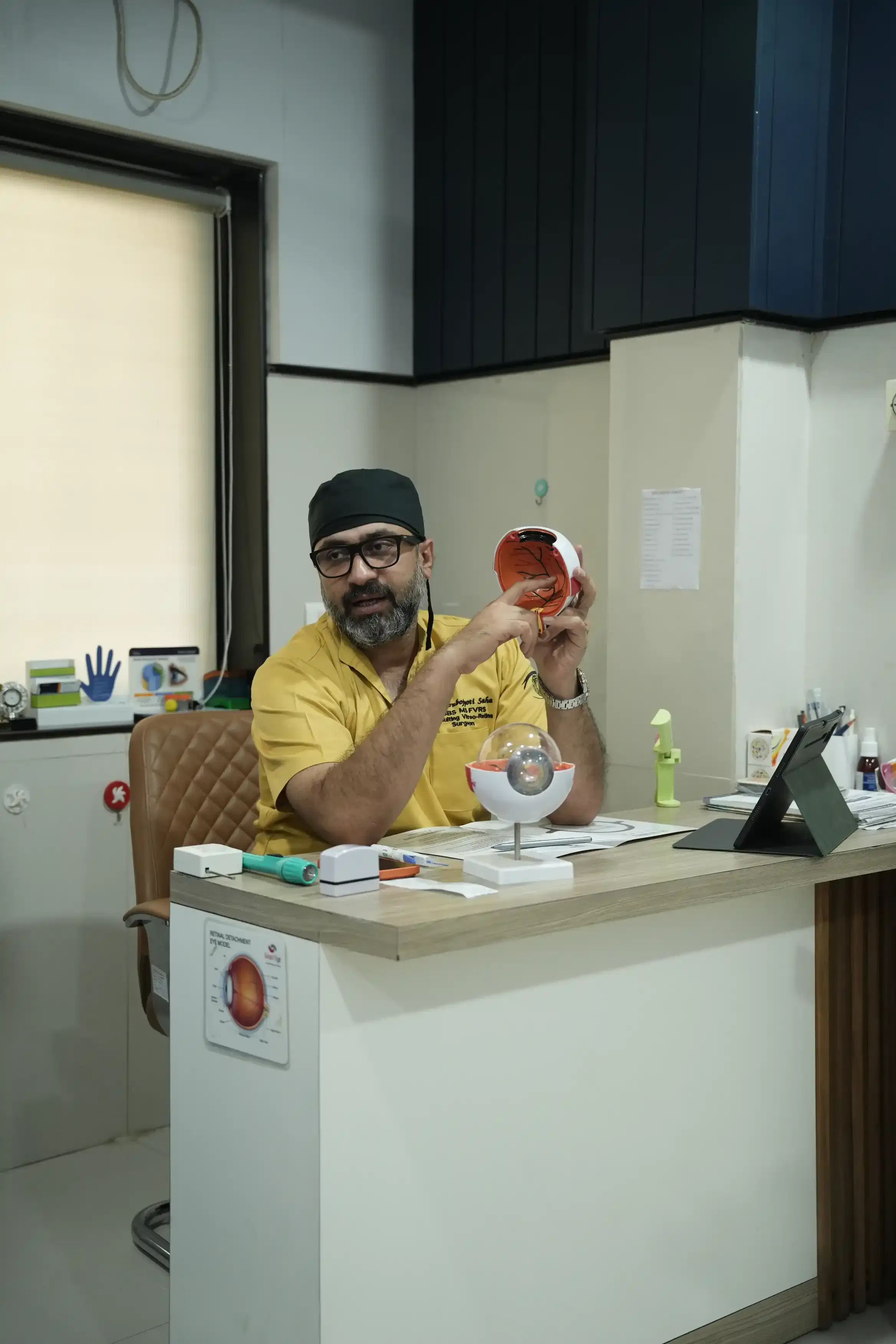
A specialist eye examination is important if you have diabetes, if your blood sugar control has been unstable, or if you have never had a recent retinal screening. A timely review can confirm whether you need monitoring, laser treatment, or another next step.
Diabetic Macular Oedema — A Hidden Threat at Any Stage Alongside these stages, fluid can accumulate in the macula — the central part of the retina responsible for sharp, detailed vision. This is called diabetic macular oedema, and it can occur even in early stages of retinopathy, causing blurring that directly affects reading, driving, and recognising faces.
A Typical Clinical Picture We See in Our Clinic
It is common for a patient with diabetes of 8 to 12 years' duration, with reasonably controlled blood sugar and no visual complaints, to come in for a routine check-up only to be found on OCT scan to already have moderate non-proliferative diabetic retinopathy with early macular thickening. In such cases, the patient is often surprised — they had no blurring, no pain, nothing to suggest a problem. This is precisely why diabetic retinopathy is called a silent disease, and why screening based on the duration of diabetes — not on symptoms — is the only reliable approach. With timely intervention, such as a course of intravitreal injections combined with strict sugar control, the disease can usually be stabilised and vision preserved before any permanent damage develops.
Why You Should Never Wait for Symptoms
One of the most common things I hear from patients is, 'But doctor, my vision is fine, why do I need a retina check?' This is the exact misconception that leads to delayed diagnosis. The retina has no pain receptors, and in its early stages, damage to peripheral parts of the retina does not affect central vision at all. By the time blurring, distortion, or sudden vision loss occurs, the disease has often already reached a moderate or advanced stage — at which point treatment becomes more complex and the chances of full visual recovery reduce significantly. This is why every major ophthalmology body, including the All India Ophthalmological Society, recommends scheduled screening based on how long a person has had diabetes — not based on whether they feel a problem.
Recommended Diabetic Eye Screening Schedule
Treatment Options for Diabetic Retinopathy
The good news is that diabetic retinopathy, when detected at the right stage, is very manageable. Treatment depends on the stage and severity:
1. Strict Blood Sugar, BP & Cholesterol Control
This remains the single most important factor at every stage. Even the best eye treatment cannot outpace poorly controlled diabetes.
.2. Intravitreal Injections (Anti-VEGF Therapy)
For diabetic macular oedema and proliferative retinopathy, injections directly into the eye reduce swelling and shrink abnormal blood vessels. These are given in a course, typically monthly initially, then spaced out based on response.
3. Retinal Laser Therapy (Photocoagulation)
Laser treatment seals leaking vessels and can prevent abnormal vessel growth in proliferative disease. It remains a highly effective and time-tested treatment for appropriate cases.
4. Vitrectomy Surgery
In advanced cases with vitreous haemorrhage or retinal detachment, surgery to remove blood and scar tissue from the eye becomes necessary to restore and protect vision.
Frequently Asked Questions
Q1. I have had diabetes for 5 years and my vision is perfectly normal. Do I really need a retina check?
Yes. Diabetic retinopathy in its early stage causes no symptoms whatsoever. The duration of diabetes — not how your vision feels — determines your risk. A dilated retina examination or OCT scan is the only way to know for certain.
Q2. Is diabetic retinopathy curable?
It is not 'cured' in the sense of reversing existing damage, but it is highly treatable and controllable. With timely intervention, vision loss can usually be prevented or significantly slowed, and existing swelling can often be reduced.
Q3. Will controlling my sugar levels alone fix my retina problem?
Good sugar control is essential and slows progression, but once retinopathy has reached a moderate or advanced stage, medical treatment — injections, laser, or surgery — is usually needed alongside sugar control, not instead of it. Q4. How often should a diabetic get an eye check-up in Nagpur? At minimum, once a year if no retinopathy is detected. If retinopathy is already present, your retina specialist may recommend a follow-up every 3 to 6 months depending on severity.
Q4. How often should a diabetic get an eye check-up in Nagpur?
At minimum, once a year if no retinopathy is detected. If retinopathy is already present, your retina specialist may recommend a follow-up every 3 to 6 months depending on severity.
Q5. Where can I get diabetic retinopathy treatment in Nagpur?
Total Retina Eye Care at Shanti Prabha Nursing Home, Lokmat Square, Dhantoli, Nagpur offers complete diabetic eye care — OCT scanning, intravitreal injections, retinal laser therapy, and vitrectomy surgery under one roof. Call 7420955541 to book a screening.
Final Words from Dr. Dhrubbojyoti Saaha
If there is one message I want every diabetic patient in Nagpur to take away from this article, it is this: do not wait for your eyes to tell you something is wrong. By the time they do, the window for the simplest treatment may have already closed. An annual dilated eye examination takes less than an hour and could be the difference between lifelong clear vision and irreversible vision loss. If you have diabetes and have not had a retina checkup this year, please make it a priority — not someday, but soon.
Book Your Diabetic Retina Screening Today
Total Retina Eye Care — Shanti Prabha Nursing Home
Mehadia Bhawan, Lokmat Square, Dhantoli, Nagpur
Call: 7420955541
www.totalretinaeyecare.in | totalretinaeyecare@gmail.com