
Inside your eye sits a natural lens, normally clear that focuses light onto your retina so you can see sharply. A cataract occurs when this lens gradually becomes cloudy, like a frosted window, making vision blurry, dull, or glare-prone.
Cataracts are not a film on the eye. They are a change inside the lens itself. Eye drops cannot dissolve them. The only effective treatment is Cataract Surgery Nagpur — surgical removal and replacement with an artificial lens — a procedure that has transformed millions of lives and is one of the safest surgeries in medicine.
• Blurry or hazy vision that doesn't improve with new glasses
• Sensitivity to bright lights or glare from headlights at night
• Faded or yellowed colours
• Frequent changes in your spectacle prescription
• Double vision in one eye
Not every cataract needs immediate surgery. We use a clinical grading system to assess the density and type of cataract and decide the right time to operate. The most commonly used system grades cataracts from Grade 1 (early/mild) to Grade 4 (mature/dense).
• Grade 1 — Early Cataract: Mild cloudiness. Vision may still be 6/9 or better. Surgery not always necessary yet — we monitor at 6-month intervals.
• Grade 2 — Moderate Cataract: Noticeable cloudiness affecting daily activities. Vision typically between 6/12 and 6/18. Surgery is usually recommended at this stage.
• Grade 3 — Advanced Cataract: Significant lens opacity. Vision may be 6/24 or worse. Surgery is strongly advised as delay increases risk.
• Grade 4 — Mature / Hypermature Cataract: Fully opaque lens. Vision severely reduced — often only light perception. Surgery is urgent to prevent complications and permanent vision loss.
A thorough pre-operative evaluation is the foundation of a successful outcome. Your pre-surgery assessment at our Cataract Surgeon in Nagpur clinic includes:
• Visual Acuity Test — to measure how sharp your current vision is
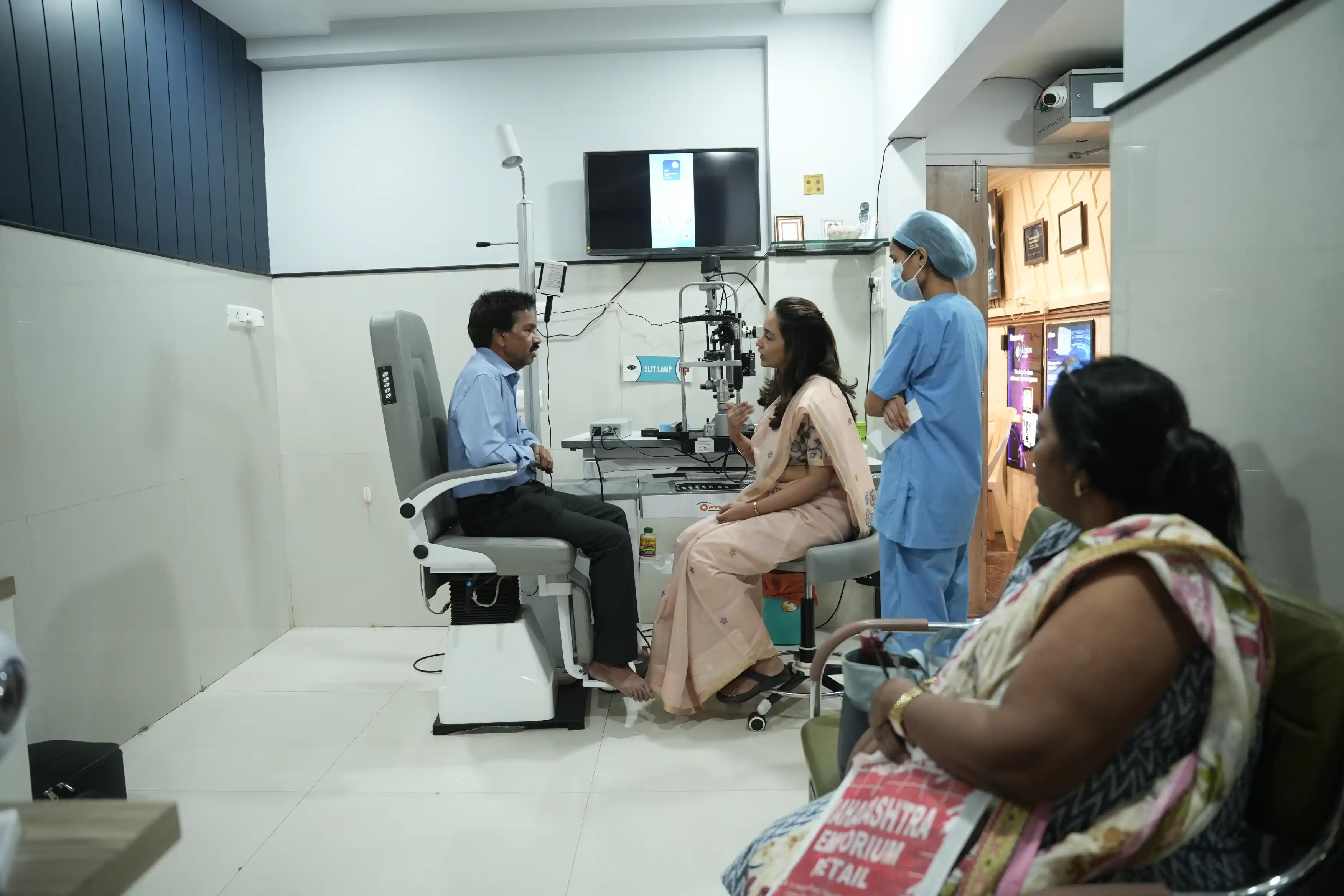
• Slit-Lamp Examination — to assess the type, density, and location of the cataract
• Biometry (IOL Power Calculation) — precise measurement to calculate the exact power of your artificial lens
• Corneal Topography — maps your cornea's shape and detects any astigmatism
• Retinal Evaluation — to ensure your retina is healthy before surgery
• General Health Check (BP & Blood Sugar) — especially important for diabetic patients in Nagpur.
Modern cataract surgery, Phacoemulsification (Phaco) is performed through a micro-incision of just 2–3mm. It takes approximately 15–25 minutes per eye and is done under local anesthesia with sedation. You are awake but completely comfortable.
• Step 1 — Anesthesia: Eye drops numb the eye completely. Most patients feel no pain only mild pressure at times.
• Step 2 — Micro-Incision: A tiny self-sealing incision (2.2–2.8mm) is made at the edge of the cornea. No stitches needed in most cases.
• Step 3 — Capsulorrhexis: A circular opening is carefully created in the front of the lens capsule to access the cloudy lens.
• Step 4 — Phacoemulsification: An ultrasound probe breaks the cataract into tiny fragments, which are gently suctioned out of the eye.
• Step 5 — IOL Implantation: A foldable artificial lens (IOL) is inserted through the same micro-incision and unfolds to sit in place permanently.
• Step 6 — Completion: The incision self-seals. A protective shield is placed over the eye. You rest for 30 minutes and go home the same day.
The artificial lens we implant called an Intraocular Lens (IOL) determines how well you see after surgery. Choosing the right lens is one of the most important decisions in cataract care.
• Monofocal IOL — best for standard cases and cost-conscious patients. Reading glasses needed after surgery.
• Toric IOL — best for patients with astigmatism. Usually glasses-free for distance.
• Multifocal IOL — best for patients wanting full glasses independence. Mostly glasses-free.
• EDOF IOL — best for intermediate and distance clarity with fewer halos. Minimal glasses needed.
Vision may be blurry or hazy — this is completely normal. Light sensitivity is common. Wear your protective shield while sleeping. Start antibiotic and anti-inflammatory eye drops as prescribed.
Vision gradually improves and stabilizes. Most patients notice a dramatic improvement in clarity and color brightness within 48 hours. Attend your follow-up visits on Day 1 and Day 7.
Return to most normal activities including reading, watching TV, and light work. Avoid swimming and heavy lifting for 4 weeks. Continue eye drops as instructed.
Final prescription glasses (if needed) are given only after 6 weeks, when the eye has fully healed and stabilized.
⚠ Warning Signs — Call Us Immediately If You Experience:
• Sudden decrease in vision after initial improvement
• Increasing redness or pain in the eye
• Flashes of light or new floaters
• Discharge from the eye.
To illustrate how this process unfolds in practice, here is a representative case from our Nagpur clinic. Details have been generalized to protect patient privacy.
• Patient: 62-year-old retired teacher, Nagpur
• Cataract Grade: Grade 3 — Nuclear Sclerotic (right eye)
• Lens Implanted: Toric IOL, for astigmatism correction
The patient visited our Nagpur clinic reporting difficulty reading newspapers and recognizing faces from a distance. On examination, she had a Grade 3 nuclear sclerotic cataract in her right eye with 1.5 diopters of corneal astigmatism. Her pre-operative vision was 6/36 — meaning she could only read the top two letters of the chart from 6 meters.
We recommended a Thoric IOL to simultaneously correct both her cataract and astigmatism, eliminating her need for distance glasses post-surgery. The procedure took 18 minutes under topical anesthesia with no complications.
Before Surgery: 6/36 → Day 7 After Surgery: 6/6
6/6 is perfect vision. The patient reported she could read her grandchildren's textbooks without glasses for the first time in 4 years. This result reflects what we see routinely with well-planned cataract surgery using the right IOL selection.
If blurry vision, glare, or fading colours are affecting your daily life, don't wait for a Grade 4 cataract to act. Cataract Surgeon in Nagpur at Total Retina Eye Care, Shanti Prabha Nursing Home, can assess your eyes and guide you to the right treatment timeline and lens choice.
Book a Consultation
Call Total Retina Eye Care, Shanti Prabha Nursing Home, Nagpur, to schedule your cataract evaluation, or visit us in person to speak with our team about your options.