
Almost every patient says the same word wrong the first time “phaco-what?” And honestly, fair enough. It's not a word anyone uses in daily life. But at our eye clinic in Nagpur, phacoemulsification is the cataract surgery I perform most often, and once I explain it in plain terms, most patients relax noticeably. So here's the explanation I usually give in the clinic, minus the medical jargon.
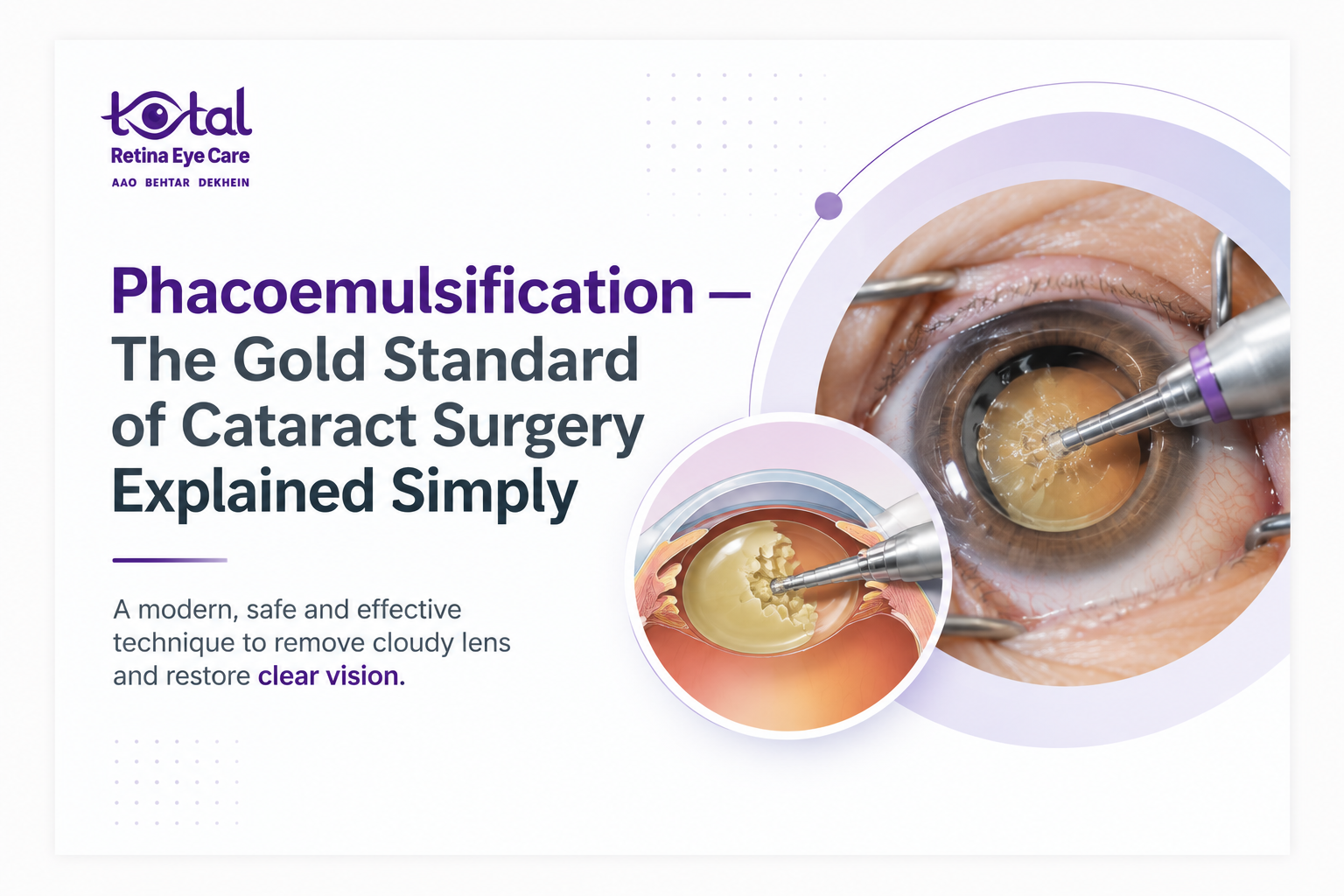
Strip away the complicated name and it comes down to this: your eye's natural lens has turned cloudy that's the cataract. Phacoemulsification is the cataract surgery technique we use to break that cloudy lens into tiny pieces using gentle ultrasound energy, and then gently suction those pieces out. Once it's out, a new, clear artificial lens goes in its place. That's really the whole idea.
A few decades ago, cataract surgery meant a much larger cut in the eye and several stitches, along with a longer, more uncomfortable recovery. Phacoemulsification changed that. Because the cataract is broken up before removal, it can be taken out through a very small incision usually around 2 to 3 millimetres which is small enough that it often doesn't even need a stitch to close. That's the real reason it has become the standard approach worldwide, and why patients travel from across the region to find the best eye hospital Nagpur has to offer for this exact procedure: smaller cut, faster healing, and far less discomfort than the older methods.
● Numbing drops are used most patients don't need general anaesthesia at all, just local anaesthesia and a mild sedative if needed
● A tiny incision is made at the edge of the cornea
● A small ultrasound probe breaks the cloudy lens into fragments and gently removes them by suction
● The thin capsule that held the natural lens is left in place, and the new artificial lens is folded and inserted through the same small incision
● The lens unfolds and settles into position no stitches are usually needed
The entire procedure typically takes 10 to 15 minutes. Patients are often surprised by how quick it is most expect something closer to an hour.
This is probably the question I get asked the most, and the honest answer is no. With numbing drops, most patients feel some pressure or mild sensation, but not pain. I've had patients tell me afterward that a dental cleaning felt more uncomfortable than the surgery itself which usually gets a laugh, but it's not far from the truth for most people.
Because the incision is so small, recovery tends to be quick. Most patients notice clearer vision within a day or two, though full stabilisation can take a few weeks. A short course of eye drops is needed to prevent infection and control inflammation, and most people are back to normal daily activities within a few days with some simple precautions like avoiding water in the eye and heavy lifting for the first week or so.
For the vast majority of cataract patients, yes it's the preferred approach regardless of age. In a small number of cases, where the cataract is unusually dense or advanced, a slightly different technique may be needed, but this is decided during the pre-surgery evaluation at our eye clinic in Nagpur, not something patients need to worry about beforehand.
Cataract surgery is one of the most commonly performed and safest procedures in modern medicine, but outcomes still depend heavily on the surgeon's experience and the quality of technology used. When you're evaluating a cataract specialist in Nagpur, it helps to ask about the surgeon's experience with phacoemulsification specifically, the range of lens options available, and the clinic's approach to follow-up care. Choosing a well-equipped eye clinic in Nagpur one that combines an experienced surgical team with modern phaco machines and a comfortable patient experience makes the entire journey, from diagnosis to recovery, far smoother.
Phacoemulsification sounds far more complicated than it actually is. In simple terms: break up the cloudy lens, remove it gently through a tiny cut, place a new clear lens in its spot. It's quick, it's not painful, and it's the reason cataract surgery today looks nothing like it did a generation ago. If you're searching for the best eye hospital Nagpur has for cataract care, this is exactly the kind of procedure and the kind of care worth asking about.
Have questions about your own cataract surgery? Come in for a consultation I'm happy to walk you through exactly what to expect for your specific eyes.
Mehadia Bhawan, Lokmat Square, Dhantoli, Nagpur, Maharashtra 440012
074209 55541
www.totalretinaeyecare.in
